


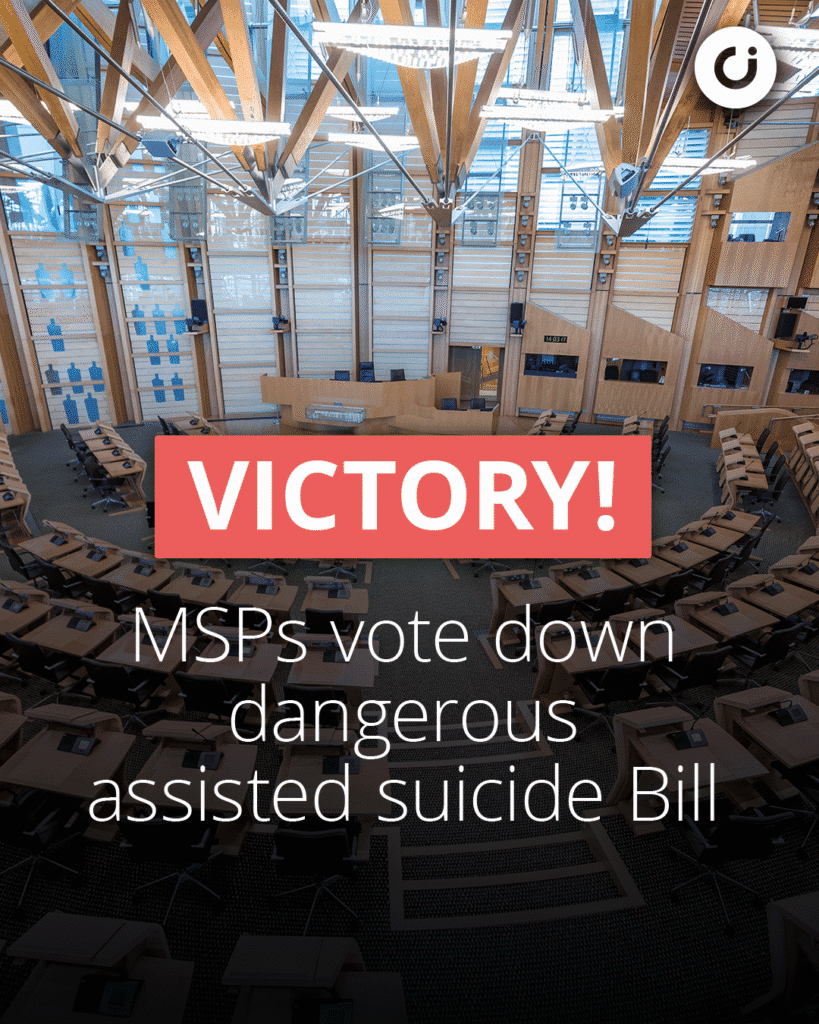
The Scottish Parliament has rejected an attempt to legalise assisted suicide for adults deemed to be terminally ill with less than six months to live.
In a conscience vote, MSPs defeated Liam McArthur’s Assisted Dying for Terminally Ill Adults (Scotland) Bill by 69 votes to 57, with one abstention. The Bill has now fallen, and will not be debated further. It is the third time in sixteen years that Holyrood has refused to endorse state-sponsored suicide.
The vote followed widespread opposition to the proposals, with the Royal Pharmaceutical Society and The Royal College of Psychiatrists in Scotland recently highlighting the risks to both medics and patients.
No safe Bill
The Christian Institute’s Simon Calvert responded: “We thank God that MSPs got the message that they simply could not pass this wretched Bill.
“The many constituents who contacted their elected representatives can take a bow. So many colleges of medicine and disability groups expressed concern about the risks to the vulnerable and the sheer unworkability of the proposals.
“I think the lesson for Holyrood – and for Westminster too – is that there is no such thing as a ‘safe’ assisted suicide Bill. Instead of offering death to the sick, we invite the MSPs who lost the vote today to transfer their campaigning energies to offering them better palliative care instead.”
‘Dangerous law’
Former First Minister Humza Yousaf spoke eloquently, explaining that while he had seen his uncle die a slow death that was hard to observe as a family member, he felt there is still far too much room for self-coercion in the Bill.
“If to give a small minority this option, we create a law under which even one person ends their life because they feel guilty, dependent, or like a burden, then this parliament will not have made compassionate law, it will have made dangerous law.”
SCOTLAND ASSISTED SUICIDE FINAL DEBATE:
“When the unintended consequences are death, there is no correcting it afterwards” – Former First Minister Humza Yousaf says Scotland must not pass a law with irreversible consequences. pic.twitter.com/NsHIpYWrXz— The Christian Institute (@christianorguk) March 17, 2026
Daniel Johnson, who voted in favour of the Bill at Stage 1 but opposed in the final vote, said: “Very often when we legislate in this place, ‘good enough’ is good enough. Legislation, by necessity, has to be a matter of compromise, but this is not an area where we can afford compromise.
“‘Good enough’ is not good enough. And I say to members: If you are seeking solace from the statements of people in this chamber that this Bill has more safeguards than any comparable legislation, you are mistaken.”
SCOTLAND ASSISTED SUICIDE FINAL DEBATE:
“Good enough is not good enough” – Daniel Johnson, who voted in favour at Stage 1, tells MSPs that safeguards are still lacking, and they should not vote for a Bill that puts people’s lives at risk. pic.twitter.com/uUh681abpC— The Christian Institute (@christianorguk) March 17, 2026
Disabled fear
Jeremy Balfour, who was born with a physical disability, said: “Disabled people are frightened. I want to ask my colleagues to put themselves in my shoes and their shoes.
“Imagine you relied on your family and friends to make daily sacrifices to help you get up, dressed, and ready for the day. Imagine being told by many people, including a number of politicians, that you are a burden on society, and the benefits that you rely on to survive could be better spent elsewhere.
“I want you to imagine that you’ve heard on numerous occasions the words ‘I’d rather die than live like you’. How do you think you would feel watching this debate? I think you would rightly feel terrified.
“I know that those on the other side will say that this Bill only affects those with terminal illness, but as has been seen time and again in other jurisdictions, this Bill marks the beginning of a story, not the end.”
SCOTLAND ASSISTED SUICIDE FINAL DEBATE:
“Disabled people are frightened” – Jeremy Balfour explains how legalisation would change the very fabric of Scottish society. pic.twitter.com/GhIJhRK0Xk— The Christian Institute (@christianorguk) March 17, 2026
‘My blood runs cold’
And Ruth Maguire spoke of her own experience of living with a terminal diagnosis: “I find it really hard to put into words the impact that the language of ‘dignity and compassion’ being used to talk about ending life has had on me. As if somehow wishing to carry on, but with help, is undignified and burdensome; unfair to people who love me.
“And that’s just in the context of us talking about it in here. My blood runs cold thinking about sitting in a room in a hospital and having a doctor raise that with me, as we weigh up treatment options.”
She added: “I want colleagues to see that if it weighs so heavily on me, someone in a position of financial privilege, with a large loving family, who are able to care for each other – indeed someone whose job it’s been for ten years to have difficult conversations and debates and have my own views and beliefs challenged – I want colleagues to see how this plays out for people who don’t have the privilege that we have.”
SCOTLAND ASSISTED SUICIDE FINAL DEBATE:
“For some women the danger that this legislation becomes another lethal tool to be wielded by an abuser is real” – Ruth Maguire on the potential for abuse under Liam McArthur’s Bill. pic.twitter.com/QIQteDTIFP— The Christian Institute (@christianorguk) March 17, 2026
MSPs debate hundreds of amendments to dangerous assisted suicide Bill
From coercion to conscience: Medics warn MSPs of assisted suicide Bill’s risk to the vulnerable