


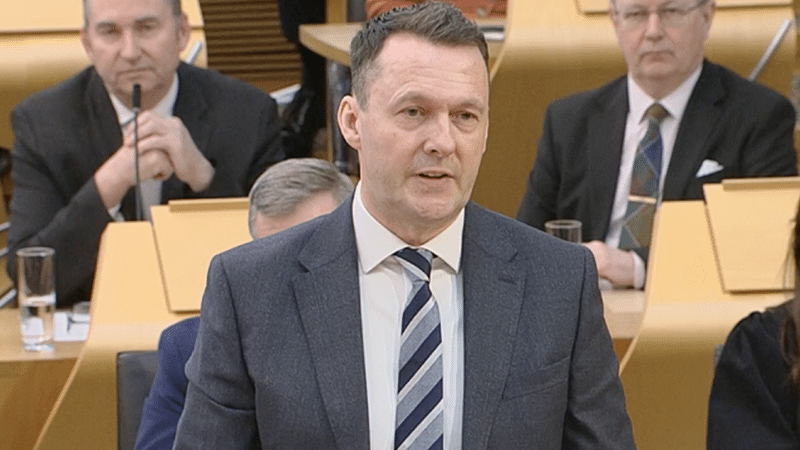
The leader of the Scottish Conservatives has withdrawn his support for Liam McArthur’s assisted suicide Bill.
MSP Russell Findlay explained that while he agrees with assisted suicide in principle, he does not believe the Bill has adequate protections to prevent coercion or prevent eligibility criteria from being expanded.
McArthur’s Bill, which would allow those deemed to be terminally ill to get help from a medic to kill themselves, passed Stage 1 by 70 votes to 56. Several MSPs said they only voted in favour of the proposals to allow time for debate. Only four more need to follow Mr Findlay for the Bill to fall at Stage 3 on 17 March.
Risk of coercion
The West Scotland MSP identified two primary concerns with the proposals, which he raised in the Stage 1 debate and feels have not been satisfactorily addressed during the Bill’s passage though Holyrood.
some elderly people may feel pressured to end their lives
There is a “real risk”, he argued, “that people could be coerced into ending their own lives”. He continued: “Not everyone is fortunate enough to have a loving and supportive family. There are already cases in which unscrupulous relatives, or ‘trusted’ medical or legal professionals, exploit elderly people for financial gain.
“And even without any coercion from others, some elderly people may feel pressured to end their lives because they think they have become a ‘burden’ on loved ones.”
‘Slippery slope’
Secondly, Findlay also warned that it seems “inevitable, that people whose conditions do not qualify for assisted dying as legislated for would take legal action to extend that right to them”.
some elderly people may feel pressured to end their lives
The MSP noted how this has happened in other jurisdictions, adding: “I would be deeply uncomfortable at being responsible for legislation that might end up mutating beyond its original remit to, for example, allowing someone with a mental health condition to compel the state to prematurely end their life.”
He stated that “the risks are too great for this bill to become law”.
Collateral damage
Writing in The Herald, Isabelle Kerr — Centre Manager at a Rape Crisis Centre in Ayrshire — highlighted the danger of coercion in the case of domestic abuse under the Bill.
Kerr, who has worked at such centres since 1981, noted: “My work has given me in depth knowledge of domestic abuse and coercive control – crimes that are highly relevant to the Bill at Holyrood.”
She pointed out: “It is unrealistic to assume that domestic abuse will cease when a woman receives a diagnosis of terminal illness”, and explained that assisted suicide “could provide a conducive context for an abuser’s ultimate act of control”.
After looking into the legislation, Kerr felt “duty bound” to tell MSPs that the Bill “is not workable in its approach to detecting coercion” and risks women in abusive situations becoming “collateral damage”.
From coercion to conscience: Medics warn MSPs of assisted suicide Bill’s risk to the vulnerable
Another MSP withdraws support for assisted suicide Bill
Assisted suicide: ‘My spinal stroke opened my eyes to subtle coercion’