


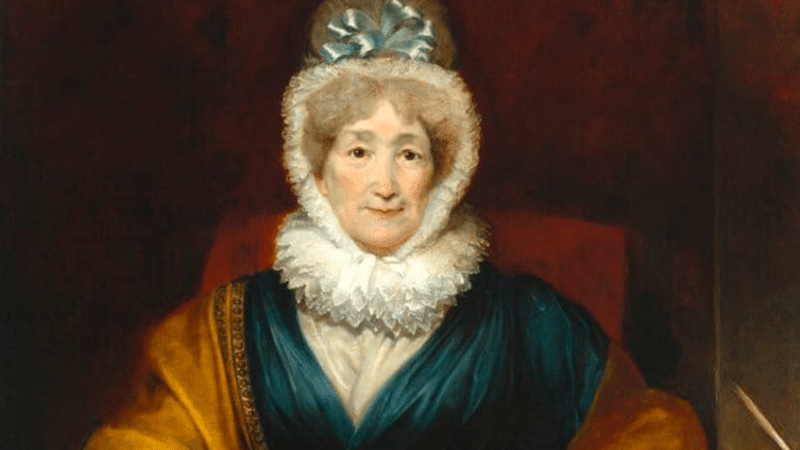
Letters from writer and Christian campaigner Hannah More (1745-1833) to fellow abolitionist William Wilberforce are now available to view online.
The collection, part of More’s correspondence that has already been transcribed and digitised, reveals her concern for Wilberforce’s campaign against slavery and their shared evangelical convictions.
Shortly after her first meeting with Wilberforce in 1787, More published ‘Slavery, A Poem’ in support of his battle to end Britain’s involvement in the slave trade.
Faith and works
In 1794, as Wilberforce faced parliamentary setbacks with his Foreign Slave Bill, More told him, “there are few things I am more anxious about than the completion of Your important Work”.
Several years later, deeply troubled at the plight of the West Country poor, she confided in him: “I exert myself however outwardly that I may not dishonour that holy name by which I am called; forgive this Obtrusion of my selfish sorrows and pray for me that my faith fail not, and that I may be supported to the End”.
Believing that she was near to death in 1828, she wrote to her friend of forty years: “It is a faithful saying and worthy of all acceptation that Jesus Christ came into the World to save Sinners. How do they meet Death who look not to this blessed Propitiation”.
Her letters to Wilberforce — of which 78 can now be viewed at Hannah More Letters Online — are scattered with biblical allusions and quotations, including: “crown of Glory”, “the Throne of grace” “God’s will be done”, “May all work together for good”, and “God’s ways are not as our ways”.
‘Significant resource’
The project website explains: “During her career More was an intimate friend of, amongst many others, David Garrick, Samuel Johnson, Horace Walpole, William Wilberforce, and Elizabeth Montagu – leader of one of the most famous literary salons of the period, the Bluestockings.
“More’s correspondents were some of the most prominent politicians, intellectuals, authors, and actors of the age; her letters provide, therefore, an extremely significant resource for understanding the nature not only of More’s literary network but also wider society in the late Georgian period.”
The open access enterprise hopes to produce “a reliable edition of More’s correspondence, which amounts to 1800 letters spread across more than eighty institutions in North America and the UK”.