


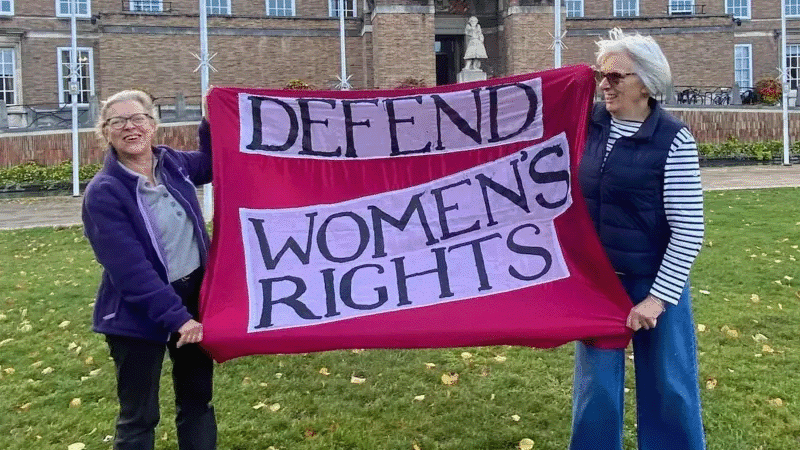
Campaigners banned from Bristol City Hall over their belief that sex is binary and immutable have been vindicated.
Dr Phoebe Beedell and Wendy Stephenson took legal action after they were excluded from Bristol City Council meetings for urging officials to abide by the Supreme Court’s ruling that sex is determined by biology, not ideology, for the purposes of the Equality Act 2010.
In an out-of-court settlement, the women — both members of the gender-critical group the Women of Wessex — have received unreserved apologies and been exonerated of any wrongdoing.
Free speech
Dr Beedell said: “This is a victory for our freedom of speech and democracy. Councillors cannot silence women who know that sex is real and matters every day of our lives. Women have rights to their own spaces for safety, privacy and dignity.
“It’s not just about toilets and changing rooms, it’s about respecting women as human beings who are equal but different to men.”
Councillors cannot silence women who know that sex is real and matters every day of our lives.
Stephenson added: “After what has been a long and difficult dispute, I hope this settlement draws a line under what happened to us.
“More importantly, I hope it makes City Hall a place where difficult questions can be debated rather than closed down, and where councillors and members of the public can disagree without lawful dissent being treated as wrongdoing.”
Policy change
A Bristol City Council press release stated that it “recognises the importance of public participation in local democracy and the right of members of the public to express lawful views, including views on matters of public controversy, when engaging with Council meetings and public forum processes”.
It also apologised “unreservedly to Ms Stephenson and Dr Beedell for the distress and any reputational harm caused”.
In August, prior to the settlement, the Council updated its Trans Inclusion and Gender Identity Policy to reflect the Supreme Court ruling and EHRC Code of Practice. The policy acknowledges that “sex refers to sex recorded at birth (male or female), and this is distinct from the protected characteristic of gender reassignment”.
It also recognises that people “hold a range of views about sex and gender” and that those who “hold gender critical beliefs are protected from discrimination by the Equality Act 2010 under the characteristic of Religion or Belief”.
Protection
Earlier this year, Wiltshire councillor Bobby Seymour was reported to officials for being “transphobic” and breaching the Councillor Code of Conduct after he criticised plans for the town’s civic honours policy to embrace ‘inclusive’ terms such as “Person of Distinction” or “Honorary Citizen”.
But Wiltshire Council’s Democracy and Complaints Manager Henry Powell ruled: “Political expression attracts a high level of protection, including statements which may shock, disturb or offend, and the Code is not intended to prevent robust disagreement about policies or political ideas.
“Some of the language used was strongly expressed and was understandably experienced by the complainant as offensive and dismissive. Nevertheless, when read in context, the comments were directed principally at the proposal, the political approach attributed to its supporters, and wider questions of public policy. They did not amount to a direct personal attack on the complainant.”

The Proclaimers: ‘Trans activists are truth-phobic’
Scope apologises for cancelling choir over gender-critical views
Civil Servants troubled by ‘non-binary’ colleague dressing as a cat