
Lamenting unborn lives lost since the Abortion Act


COMMENT
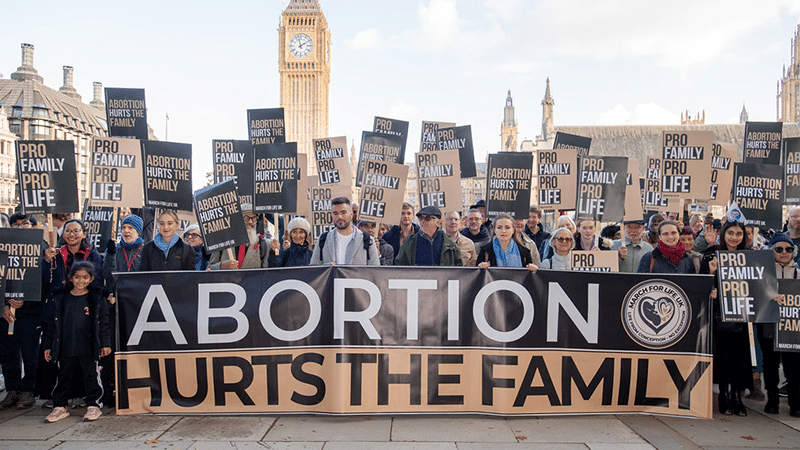
People from around the country gathered in Parliament Square on Tuesday 27 October to mark the anniversary of the Abortion Act, passed on 27 October 1967.
The tone was sombre, as we lamented the loss of more than 11 million unborn lives since the passing of that act.
Today in Britain, a baby is aborted every two minutes. Babies deemed to have abnormalities can be aborted up to birth. As if that weren’t enough, earlier this year Parliament passed a form of “abortion decriminalisation”, so that a woman is now able to kill her unborn baby at any stage of pregnancy without sanction.
MP Carla Lockhart, a stalwart defender of unborn life, joined the event, as did former Cabinet Minister Sir Jacob Rees-Mogg, who commented that abortion is “the great issue” of our time.
Both lives matter
Every unborn life is precious. From fertilisation, there is an absolutely unique individual. By ten weeks’ gestation, the unborn baby has fingers, toes, organs and brain activity. We all know when we see the 12-week scan of our baby, or hear their heartbeat, that this is a precious child, not just disposable fetal matter. Women are betrayed when they are told that abortion is just a minor procedure.
The deliberate taking of an innocent human life is wrong. It violates the sixth commandment: “You shall not murder.” Whenever it’s carried out, and however it’s carried out, abortion is never right. It deliberately ends the life of a living human being.
And countless mothers are left with lasting regret. Both lives matter. We are thankful that so many women have found the forgiveness and healing to be found in Christ, and thankful for the many churches and ministries that offer faithful and compassionate post-abortion care and counselling.
The taking of more than 11 million unborn lives has been a great evil. We gathered in front of Parliament to lament. But we are to pray and work towards a time when our society turns away from the culture of death and embraces a culture celebrating the dignity and value of every human life.
This article was first published by Evangelicals Now (en) and is reproduced here with permission.
By Sharon James, Social Policy Analyst