
City of God: 1,600 years of influence


Born in Thagaste, a city under Roman rule in modern-day Algeria, Augustine of Hippo (354–430) was the son of a pagan father but Christian mother, Monica.
As a young student, Augustine excelled in rhetoric, going on to study in Carthage, and even starting his own school in Rome. By 30, he had been appointed Professor of Rhetoric in Milan, embraced the false religion of Manichaeism and was involved in a 15-year relationship with a concubine.
In an exalted position at a relatively young age – giving official speeches in praise of the emperor – many doors were open to him in the years ahead, especially in politics. Yet in Milan he met the Christian theologian Ambrose and the earthly future he had mapped out was turned on its head, as Ambrose became a spiritual father to Augustine and led him to the knowledge of Christ.
Monica’s longstanding prayers bore fruit as Augustine was converted, and then baptised on Easter Sunday in 387. He would then become one of the most influential theologians in the history of the Church. He was a prolific author, but he is remembered for two texts in particular which tower over the Church’s later theological reflection: Confessions and City of God.
City of God
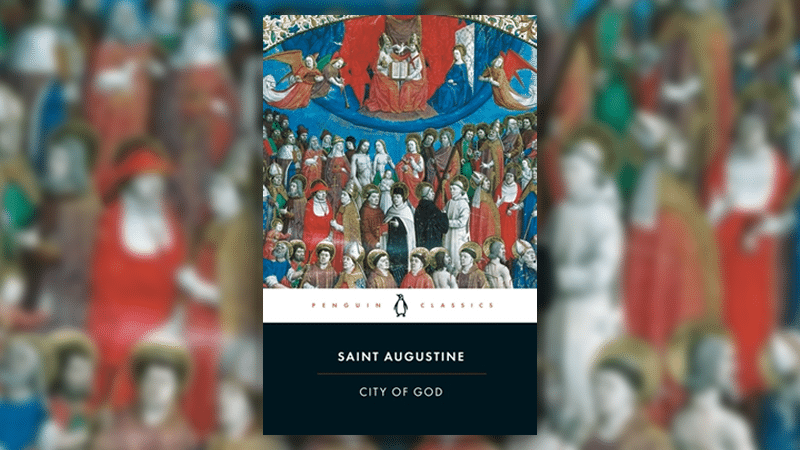
A monumental work of apologetics, history and theology, City of God was completed 1600 years ago in 426, and was a response to those who claimed that embracing Christianity and turning away from the old Roman gods had brought disaster on the Empire.
Religious freedom had been granted to Christians within the Roman Empire by Constantine in 313 via the Edict of Milan, and Emperor Theodosius I had declared Christianity the official religion of the Empire in 380 with the Edict of Thessalonica. But in 410, Rome was sacked by the Visigoths, and enemies of the Church charged it to the pagan deities’ punishment of the Empire for its betrayal.
Augustine’s response to the opponents of the Christianity was combative and resolute. He described how pagans and Christians alike had sheltered in the Church’s basilicas and weren’t killed: “The barbarians spared them for Christ’s sake; and now these Romans assail Christ’s name.” By prayerfully wrestling with these assaults on Christ’s name through more than a decade of writing, Augustine brought forth a massive, 22 book account of God’s work in the world.
In a letter to a Christian friend, Augustine explained the structure of City of God and sent a gift of the manuscript. He explained that the 22 books could be organised in five parts. In part one, Augustine argues “against those who maintain that the worship of the gods – I would rather say of the evil spirits (daemones) – leads to happiness in this life.”
Part two was then “written against those who think that suchlike deities are to be worshipped by rites and sacrifices in order to secure happiness in the life to come”. After that, part three describes the “origin of that City” whose founder is God. Part four discusses this Heavenly City’s “progress, or rather its development”, and part five considers “the ends in store for it” – the glory of its ultimate destiny.
People of God
Over more than a thousand pages, Augustine presents a picture of two contrasting cities – the City of God and the City of Man. “By two cities I mean two societies of human beings, one of which is predestined to reign with God for all eternity, the other doomed to undergo eternal punishment with the Devil.”
There is the sinfulness and depravity of life in the earthly city apart from Christ, “a city which aims at dominion… but is itself dominated by that very lust of domination”, and the stark juxtaposition with the ultimate beauty and holiness of life in the City of God.
Augustine believed that “the peace of the Heavenly City is a perfectly ordered and perfectly harmonious fellowship in the enjoyment of God, and a mutual fellowship with God”. And as the Heavenly City progresses “on pilgrimage in this world” towards everlasting glory, he wrote, “she calls out citizens from all nations and so collects a society of aliens, speaking all languages”.
But even as believers are a part of the City of God, we are commanded by God to love both God and neighbour, meaning Christians have a God-given responsibility to work for the common good of the City of Man. Our primary goal is to glorify God, and we do that as dual citizens, working for the good of fellow man, whether they are believers or not. As Jesus preached in the sermon on the mount: “let your light shine before others, that they may see your good deeds and glorify your Father in heaven” (Matthew 5:16).
After 1600 years, many other empires have risen and fallen, but Augustine’s description of the City of God, a people redeemed and preserved by Christ, holds true as a biblical vision of our calling to be salt and light.
Learn more about Augustine and the City of God